We offer a wide collection of free, high-quality printable coloring pages for kids and adults. From cute animals to intricate mandalas, our designs bring creativity and relaxation to everyone. Download, print, and start coloring today!

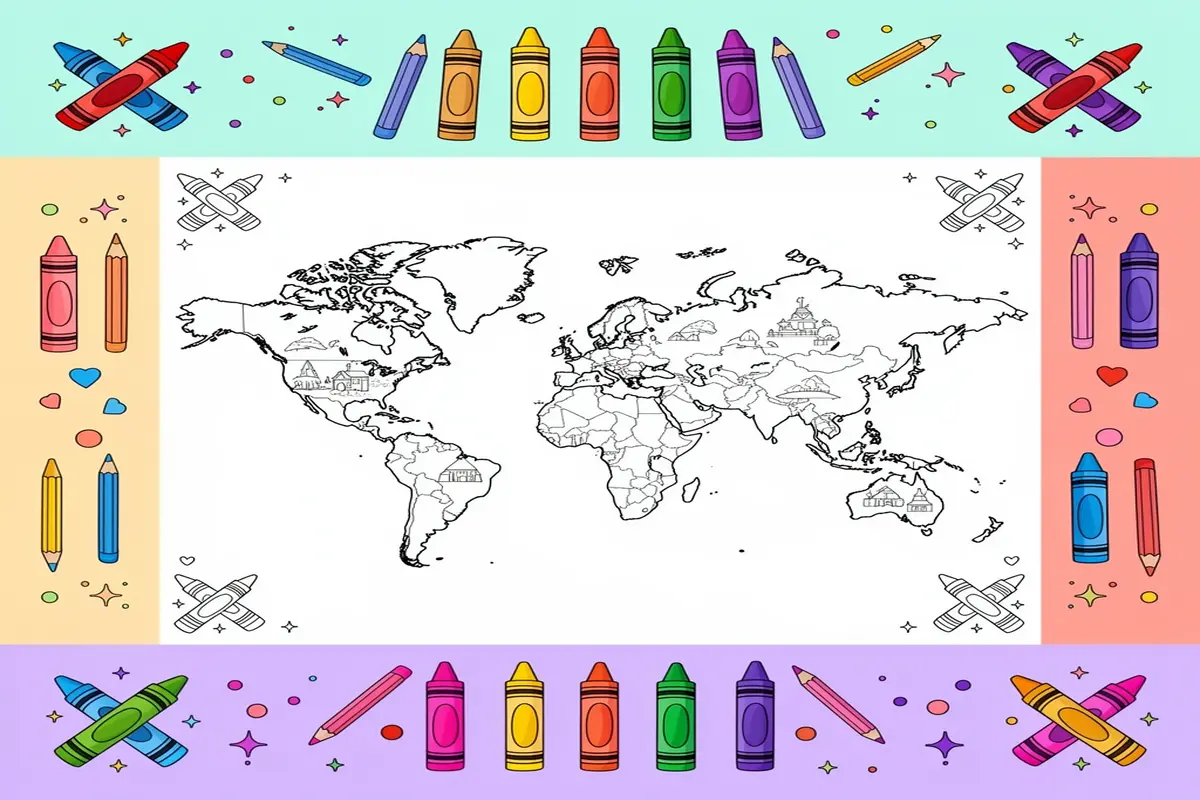
In an age of digital saturation, the simple act of coloring offers a profound return to tactile, imaginative play. It’s a quiet space where focus deepens, creativity flourishes, and young minds embark on journeys limited only by their palette. Among the most enriching of these artistic adventures are world map coloring pages for kids. These are not mere outlines; they are gateways to global curiosity, transforming geography from a abstract concept into a personal, colorful masterpiece. As children select hues for continents and oceans, they aren’t just staying within lines—they are internalizing the shape of our planet, fostering a foundational sense of connection and wonder. This activity beautifully bridges artistic expression with early education, making it a powerful tool for parents and educators alike. For a deep dive into another educational coloring theme that sparks fascination with the natural world, explore our collection of realistic animal coloring pages.
The Global Canvas: More Than Just Geography
At first glance, a world map coloring page for kids is a lesson in topography. But look closer, and it reveals itself as a multidimensional tool for cognitive and emotional development. The process of coloring this particular subject engages a unique blend of skills, turning a quiet activity into a dynamic learning experience.
The Psychology of Color: Building a Mindful Explorer
The act of coloring is widely recognized for its calming, meditative benefits, promoting mindfulness and reducing anxiety. When applied to a world map, this soothing effect is coupled with purposeful choice. Deciding if Australia should be golden yellow or vibrant green isn’t arbitrary; it’s an exercise in decision-making and personal expression. This combination of focused attention and creative control helps build neural pathways associated with both relaxation and executive function. A child meticulously shading the vast Pacific Ocean is practicing patience and fine motor skills, all while in a state of flow.
A Tapestry of Cultures: Coloring Beyond the Borders
Every continent colored is an invitation to learn. A parent or teacher can use a world map coloring page for kids as a springboard for conversation: “What animals live here?” “What language might children there speak?” This transforms the page from a static image into a living story. Children begin to see the map not as a collection of countries, but as a home for billions of people, diverse ecosystems, and incredible wildlife. It naturally cultivates empathy and global awareness, planting seeds for cultural appreciation that extend far beyond the art table.
Designed for Every Young Cartographer
The beauty of world map coloring pages for kids lies in their accessibility. For younger children, simplified outlines with larger areas are perfect for practicing grip and color recognition. Older kids and even adults can tackle more detailed versions featuring topographic markings, national borders, and iconic landmarks. This scalability ensures that the challenge is always appropriate, fostering a sense of accomplishment regardless of skill level. Whether used in a classroom to complement a social studies unit or at home on a rainy afternoon, these pages are a versatile resource that grows with the child, continually offering new layers of discovery and artistic satisfaction.
Part 2: Essential Materials & Preparation for World Map Coloring Pages for Kids
To transform your world map coloring pages for kids from a simple activity into an enriching and high-quality educational experience, the right materials and setup are crucial. Proper preparation not only enhances the final result but also makes the process more enjoyable and comfortable for young geographers. This section details the professional-grade supplies and preparatory steps recommended for optimal results.
The Foundation: Selecting Premium Paper for World Map Coloring Pages for Kids
The choice of paper is the single most important factor in determining the quality of your finished map. Standard printer paper (20-24 lb/75-90 GSM) is prone to bleeding, warping, and tearing, especially with wet media. For a project as detailed as world map coloring pages for kids, upgrade to a heavier, acid-free paper. A smooth Bristol board (100-110 lb/approx. 200 GSM) or heavyweight mixed-media paper provides a sturdy surface that can withstand multiple layers of color and fine detail work without bleed-through. This ensures that the intricate borders and country labels remain crisp. For a more tactile and artistic finish, consider a lightly textured watercolor paper if your child plans to use paint or water-based markers.
Best Coloring Tools: A Detailed Medium Comparison
The coloring medium defines the visual impact of the map. Each tool offers distinct advantages for world map coloring pages for kids:
Colored Pencils (Professional Grade): Ideal for precision and control. Look for pencils with soft, pigmented cores (like wax- or oil-based) that blend easily. They allow children to apply light or heavy pressure, perfect for shading oceans or adding topographical detail to mountain ranges. They are also mess-free and excellent for fine motor skill development.
Markers (Alcohol vs. Water-Based): Alcohol-based markers (blendable, bleed-resistant) offer vibrant, streak-free color ideal for large areas like continents, but require bleed-proof paper. Water-based markers are more child-friendly and easier to clean, but can cause paper to buckle. Using them with the recommended heavyweight paper mitigates this issue. For a fun thematic link, consider using shades of blue and green from our ocean coloring pages palette to inspire oceanic and landmass color schemes.
* Watercolor Paints: Excellent for teaching color mixing and creating beautiful, gradient-filled oceans. They require a bit more preparation and supervision but yield stunning, painterly results. Use with watercolor paper for best effect.
Finishing Touches: Gel Pens, Highlights, and Labeling
Elevate the completed world map coloring pages for kids with detailing tools. Metallic or opaque white gel pens are fantastic for adding highlights to ocean waves, tracing country borders, or making city dots “pop.” Fine-line permanent markers (e.g., 0.3 mm) in black or dark blue can be used to carefully redefine any outlines that were obscured during coloring. If the project is educational, consider using a set of fine-tip colored pens for children to neatly label continents, oceans, or even key countries, turning the artwork into a personalized reference poster.
Perfect Workspace: Ergonomic and Lighting Setup
A well-prepared workspace prevents fatigue and fosters focus. Ensure the coloring surface is stable, flat, and at an appropriate height to prevent hunching. Natural daylight is the ideal light source for accurate color perception; position the workspace near a window if possible. For evening sessions, supplement with a bright, white LED desk lamp to reduce eye strain. Protect the work surface with a large craft mat or newspaper, and keep a clean cloth and water cup handy for quick clean-ups. Organizing supplies within easy reach in cups or trays encourages an orderly process and allows the child to concentrate fully on their global masterpiece.
Part 3: Elevating Your Atlas: Advanced Techniques for World Map Coloring Pages for Kids
Ready to transform a simple outline into a masterpiece? Moving beyond basic fills, these advanced techniques will help your young cartographers add stunning depth, realism, and creativity to their world map coloring pages for kids. This guide is designed for parents and teachers to coach children toward professional-looking results.
Harmonious Palettes: Color Theory for Global Masterpieces
Understanding basic color theory prevents maps from becoming chaotic. Teach kids the difference between complementary and analogous schemes. For continents, use analogous colors (like blues, greens, and teals for forests and coasts) to create natural, harmonious landscapes. For highlighting country borders or map keys, complementary colors (like orange against blue oceans) make elements pop. Start with our landscape coloring pages for kids to practice these schemes on smaller terrains before tackling the whole world.
From Flat to 3D: Mastering Shading and Depth
The secret to a globe that looks round is shading. Guide children to imagine a light source (e.g., the sun in the top-left corner). Areas farther from this light, like the western edges of continents, should be slightly darker. Use gentle, layered pencil strokes or a slightly darker shade of the base color. For ocean depth, apply the same principle: coastlines are light aqua, deepening to navy blue in the open ocean. This step-by-step approach turns a flat world map coloring page for kids into a dimensional, realistic representation.
Adding Realism: Texture Techniques for Land and Sea
Different geographic features call for different textures. For deserts (like the Sahara), use small, dotted or stippled marks with a yellow-orange pencil to suggest sand. Mountain ranges can be defined with sharp, angular strokes along the ridges. For forests, like the Amazon, try tiny “V” or “cloud-like” clusters in varying greens. Oceans can gain life with gentle, wavy lines. Explore our nature coloring pages for kids to practice rendering grass, water, and rock textures on a smaller scale.
The Art of Correction: Gracefully Fixing Coloring Errors
Mistakes are part of the process! If color goes outside the lines, don’t panic. Often, it can be incorporated—a little blue “water” spill onto the coast can become a bay or river delta. For more stubborn errors, use a white gel pen or a colorless blender to lighten and blend the stray mark into the background. Teach kids that professional artists constantly adapt. The goal isn’t perfection, but a final piece where every stroke contributes to the story of their unique world. This mindset turns potential frustrations into creative problem-solving sessions, making the completion of their world map coloring pages for kids a truly rewarding achievement.
Showcasing Your World Map Coloring Masterpieces: Creative Display Ideas
Once your child has completed their world map coloring pages for kids, it’s time to celebrate their global artwork! Moving beyond the fridge, creative display turns their geography lesson into a proud, lasting piece of home decor and inspiration.
Preserving Your Masterpiece: Archival Tips
To ensure your child’s map stands the test of time, consider simple preservation methods. For a classic look, have the map laminated at a local print shop, making it durable and wipeable. Alternatively, use a clear spray fixative from an art store to prevent crayon or pastel smudging. For the most cherished pieces, invest in an inexpensive frame with a matte board. This not only protects the artwork but elevates it, showing your child that their creative and educational effort is truly valued.
Beyond Display: Creative DIY Projects
Transform completed maps into meaningful gifts and keepsakes. Carefully cut out individual continents to create unique, educational greeting cards for grandparents. Laminate and hole-punch a corner to make a worldly bookmark—a perfect pairing with adventure stories. For a collaborative family project, attach colored maps to a corkboard and use pins or string to mark places you’ve visited or dream of exploring. This interactive display grows with your family’s journey. For more creative inspiration, explore our collection of educational coloring pages that blend learning and art.
Your World Map Coloring Pages for Kids Questions Answered
How do I teach my child the world map?
Start with a simple, engaging activity like world map coloring pages for kids. As they color, name the continents and point out your home country. Use songs or stories about different places. Keep it playful and pressure-free; the goal is to build familiarity and curiosity, not memorization. Relate it to their world, like discussing where a favorite animal lives.
What do children learn from coloring maps?
Coloring maps builds far more than geography skills. It enhances fine motor control, color recognition, and spatial awareness. Children learn continent shapes, names, and relative locations, laying a foundation for global awareness. It also fosters focus, patience, and a tangible sense of accomplishment, making complex world concepts accessible and fun.
Where can I find free printable world maps?
You can find excellent, free printable world maps on educational websites, library resource pages, and sites dedicated to teacher and parent resources, like Safari Coloring. Look for age-appropriate versions—simplified outlines for younger kids and more detailed maps for older children. Always ensure you’re downloading from a reputable, safe site.
What are the standard colors for the 7 continents?
While no official standard exists, many educational maps use a common color scheme: North America (green), South America (pink), Europe (red), Asia (yellow), Africa (orange), Australia/Oceania (brown), and Antarctica (white). This is a helpful guide, but encourage creativity! The act of coloring a world map for kids is more about engagement than strict adherence to a color code.
At what age should a child learn the continents?
Children can begin recognizing continent shapes and names as early as 3-4 years old through simple puzzles and songs. More formal learning, like using labeled world map coloring pages for kids, is great for ages 5-7. Always follow your child’s interest—if they’re curious about the world, it’s the perfect time to start, regardless of age.
Final Thoughts: Your World Map Coloring Journey Begins
Embarking on the adventure of world map coloring pages for kids opens a door to global discovery right at your kitchen table. It’s more than just an art project; it’s a foundational activity that blends creativity with education, building knowledge and fine motor skills while sparking conversations about our diverse and wonderful planet. Each colored continent is a step toward raising an informed, curious, and globally-minded individual.
Remember, the goal isn’t perfection, but participation. Celebrate the effort, display the artwork with pride, and watch as your child’s confidence and understanding of the world grows with every page they complete. This simple, joyful activity plants the seeds for a lifetime of learning and exploration.
Ready for your next adventure? Explore our safari coloring pages for kids to continue the journey from continents to incredible animals!